
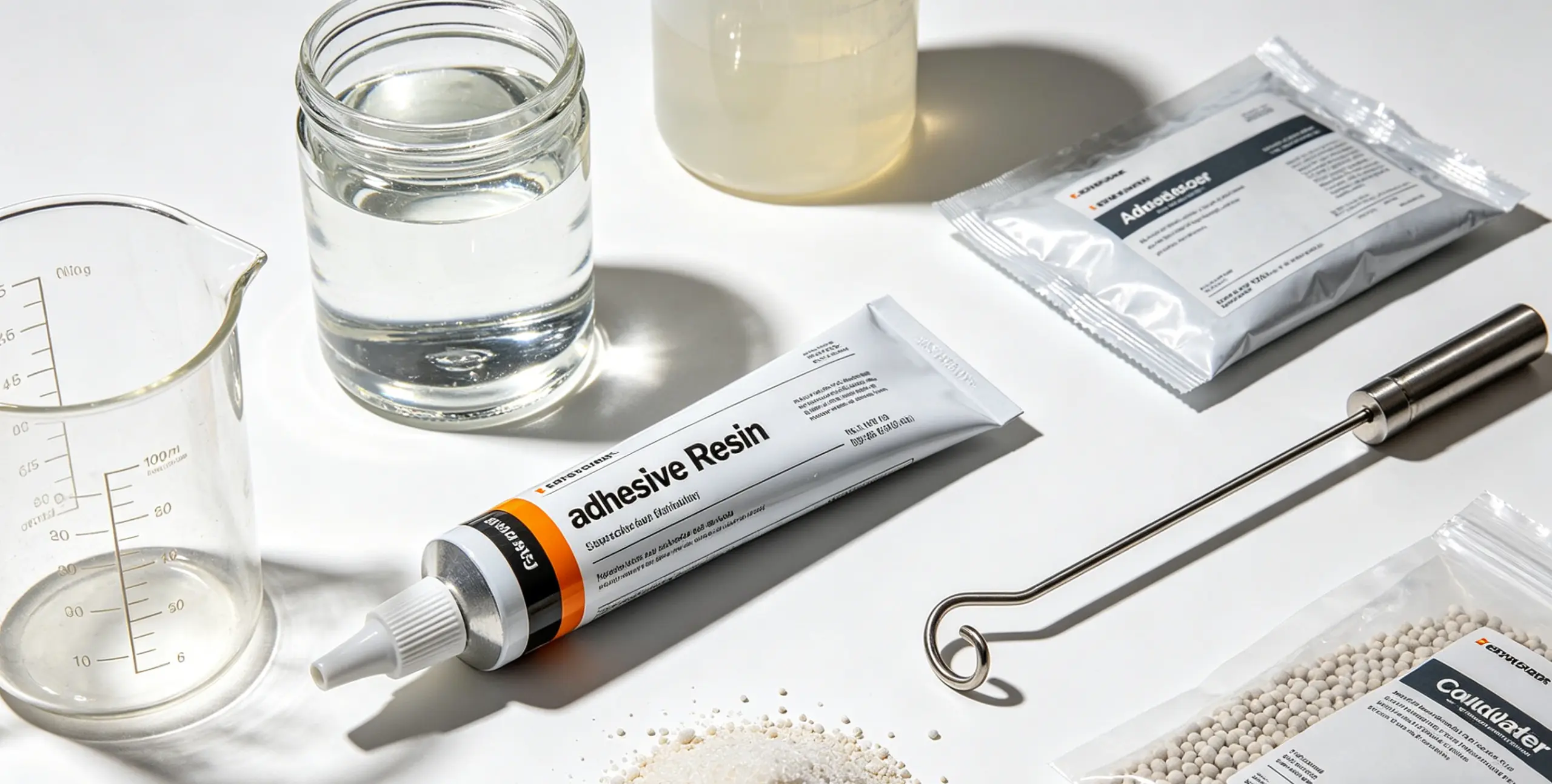
Adhesives & Resin Mixing
Adhesive Mixing & Degassing Solution for Bubble-Free Results
High-performance industrial adhesives, sealants, and resin formulations require absolute homogeneity and zero void entrapment. Trapped micro-bubbles, uneven hardener ratio distribution, and filler settling lead to structural bonding failures, dielectric breakdown in electronics, and compromised sealing integrity.
Adhesives & Resins Handled
Epoxy Systems: 1K and 2K structural epoxies, conductive epoxies, high-temperature potting resins, and underfill compounds.
Silicones & RTV Sealants: High-viscosity silicone elastomers, Liquid Silicone Rubber (LSR), optical bonding clear silicones, and thermal gap fillers.
Polyurethanes (PU) & Acrylics: Structural PU adhesives, UV-curable resins, acrylic structural bonding agents, and anaerobics.
Functional & Filled Adhesives: Silver-filled conductive pastes, alumina/boron nitride thermal grease, and silica-filled encapsulants.
Industry Applications
Electronics & Semiconductor Packaging: Underfill, die-attach adhesives, PCB potting/encapsulation, and Thermal Interface Materials (TIM).
Automotive & EV Batteries: Structural battery pack bonding, thermal gap filler mixing, module encapsulation, and sensor potting.
Aerospace & Composites: Carbon-fiber composite resin infusion, structural honeycomb panel bonding, and extreme-temperature sealants.
Medical Device Assembly: Needle bonding adhesives, catheter assembly, bio-compatible epoxy sealing, and optical adhesive potting.
Common Material Processing Challenges
Air Bubble & Void Entrapment: Viscous resins easily trap air during mixing; sub-micron voids cause dielectric failure in electronics and weak structural joint strength.
Incomplete 2K Ratio & Hardener Dispersion: Poor mixing of Part A and Part B leads to localized soft spots, incomplete curing, and degraded mechanical properties.
High-Density Filler Settling & Agglomeration: Heavy thermal/electrical fillers (metal powders, silica) settle rapidly or form clusters, causing inconsistent conductivity.
Frictional Heat & Reduced Pot Life: High-shear mechanical blade stirring generates friction heat, triggering premature curing and drastically shortening working pot life.
How Planetary Vacuum Mixers Solve These Issues
| Processing Challenge | Planetary Vacuum Mixer Solution | Technical Benefit |
|---|---|---|
| Trapped Air & Micro-Voids | High-Vacuum Deaeration (-0.098 MPa) | Removes sub-micron air bubbles entirely, preventing dielectric breakdown and bonding failure. |
| Incomplete 2K Mixing | Non-Contact Dual Rotation (Revolution + Rotation) | Achieves 100% homogeneous dispersion of Part A/B hardeners without dead zones or contamination from blades. |
| Filler Settling & Agglomeration | High-G Centrifugal Shear | Disperses heavy thermal/conductive fillers uniformly throughout viscous resins without phase separation. |
| Premature Gelation & Heat | Blade-Free Low-Friction Hydrodynamics | Minimizes shear friction heat, preserving pot life and keeping temperature-sensitive resins stable. |
Recommended Equipment
Achieving Bubble-Free Dispersion in High-Viscosity Electronic Pastes for European R&D Lab
Bubble-Free Epoxy Resin: How to Remove Bubbles Effectively
Frequently Asked Questions (FAQ)
Planetary mixing relies on blade-free hydrodynamic shear rather than mechanical friction blades, drastically reducing processing heat. Combined with short processing times (typically 2 to 4 minutes) and optional jacketed cooling adapters, your 2K formulations remain well within safe temperature limits, preserving their working pot life.
Yes. We offer custom-engineered jigs and adapters for standard 3cc–55cc syringes, 300ml–900ml cartridges, and specialized dual-barrel packaging. Mixing directly in the final dispensing container eliminates material transfer loss, prevents secondary air re-entrapment, and reduces cleanup time to zero.
Absolutely. The combination of intense centrifugal force and deep vacuum (-0.098 MPa) forces micro-bubbles out of extremely thick matrices—including heavy silicone gels, thermal gap fillers, and structural polyurethane pastes—that conventional blade mixers fail to process.