
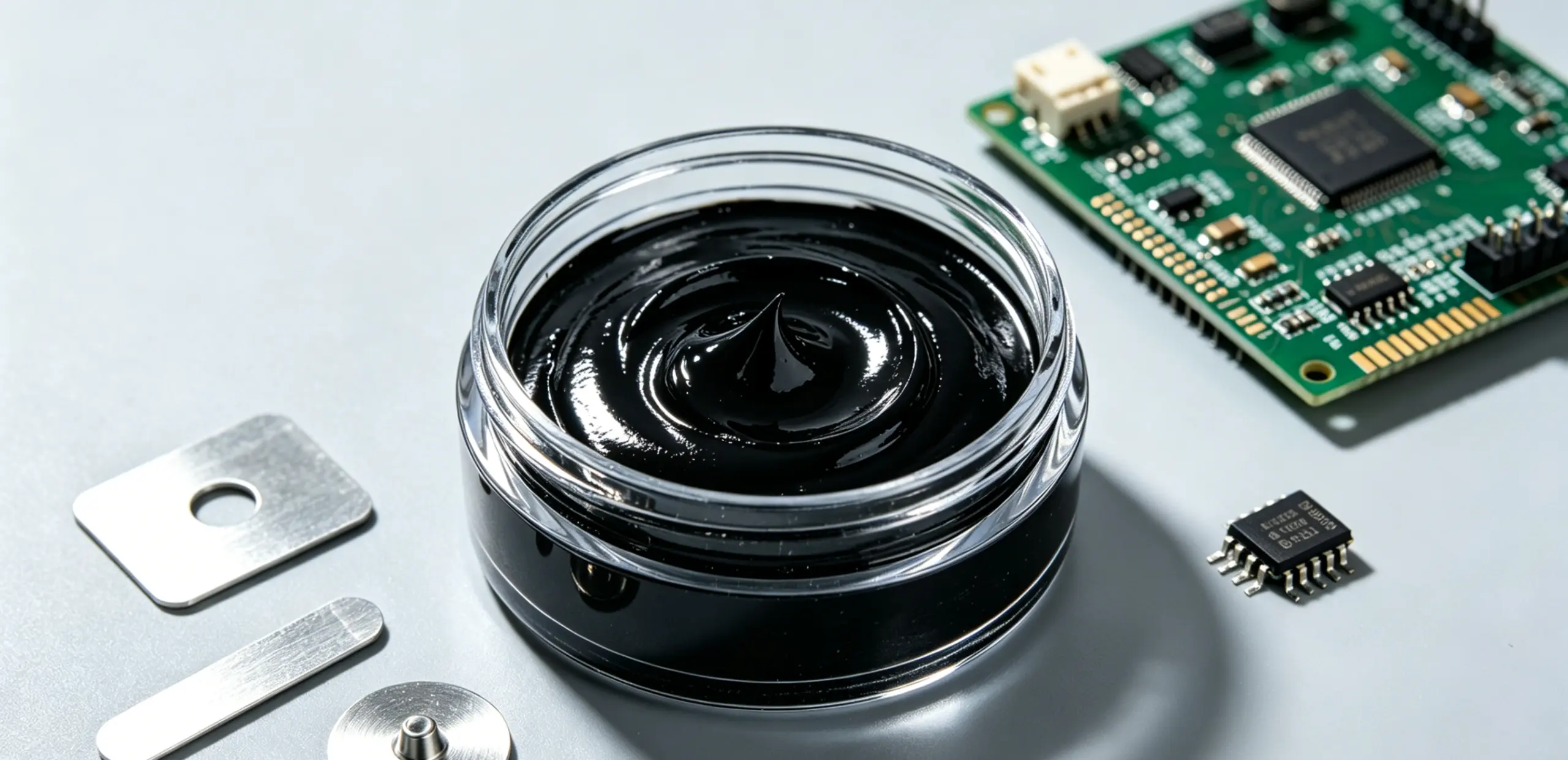
Conductive Paste & Electronics
Conductive Paste Mixing Solution | Uniform Dispersion & Bubble Removal
Precision printed electronics and semiconductor packaging require flawless conductive paste formulation. Micro-bubbles, metallic filler agglomeration, and batch-to-batch viscosity variations cause line resistance spikes, open circuits, nozzle clogging, and unreliable electrical performance in micro-dispensing and screen printing processes.
Conductive Pastes & Inks Handled
Silver & Copper Pastes: Micron/nano-silver pastes (Ag), copper-based pastes (Cu), and silver-coated copper formulations for thick-film hybrid circuits.
Carbon & Graphene Inks: Carbon nanotube (CNT) dispersions, graphene inks, and graphite conductive slurries for flexible sensors and heating elements.
Conductive Adhesives & Epoxies: Isotropically/anisotropically conductive adhesives (ICA/ACA), die-attach pastes, and silver-filled thermal grease.
Dielectric & Specialty Inks: Cross-over dielectric pastes, carbon resistor inks, liquid metal formulations, and polymer thick-film (PTF) materials.
Industry Applications
Flexible & Printed Electronics: Printed RFID antennas, membrane switches, capacitive touch sensors, and flexible wearable biosensors.
Photovoltaics (PV): Front and rear contact metallization paste preparation for high-efficiency solar cells (PERC, TOPCon, HJT).
Semiconductor Packaging: Die-attach adhesives, flip-chip underfill resins, PCB trace repairs, and micro-dispensing encapsulation.
Automotive & Displays: Defogging heating lines, Micro-LED/OLED busbar printing, capacitive touch panels, and EV sensor potting.
Common Material Processing Challenge
Micro-Voids & Electrical Open Circuits: Sub-micron air bubbles trapped during paste mixing expand during thermal curing or sintering, creating micro-voids, line breaks, and high sheet resistance.
Metallic Powder Agglomeration: High-density metal nanoparticles ($Ag$, $Cu$) form clusters in organic vehicles, clogging fine-mesh screens and dispensing nozzles while causing non-uniform conductivity.
Blade Abrasion & Impurity Contamination: Traditional metallic blade stirrers abrade over time, introducing metal flakes or polymeric impurities into ultra-pure electronic slurries.
Frictional Heat & Viscosity Instability: High-shear mechanical mixing generates friction heat, triggering premature curing of reactive resins or causing solvent evaporation that ruins printability.
How Planetary Vacuum Mixers Solve These Issues
| Processing Challenge | Planetary Vacuum Mixer Solution | Technical Benefit |
|---|---|---|
| Micro-Voids & Line Breakage | High-Vacuum Deaeration (-0.098 MPa) | Completely evacuates sub-micron air voids, guaranteeing stable electrical conductivity and zero open circuits. |
| Nano-Filler Agglomeration | Non-Contact Dual Rotation (High-G Shear) | Thoroughly de-agglomerates nano/micron metallic powders into organic vehicles, preventing screen and nozzle clogging. |
| Blade Contamination | Blade-Free Mixing in Sealed Containers | Eliminates blade abrasion and cross-contamination, ensuring 100% material purity required for semiconductor standards. |
| Heat & Premature Curing | Low-Shear Hydrodynamic Force | Minimizes friction heat during processing, keeping temperature-sensitive conductive epoxies and binders stable. |
Test Your Material Before You Buy
Recommended Equipment
Frequently Asked Questions (FAQ)
No. Unlike 3-roll mills or high-shear blade stirrers that can crush fragile flakes or shear high-aspect-ratio CNTs/graphene, planetary mixers disperse conductive fillers smoothly through fluid displacement and centrifugal shear, preserving filler geometry and maximizing electrical conductivity.
Because mixing occurs inside a sealed container without any internal blades or shafts, there is zero metal-on-metal friction. This eliminates trace metal abrasion particles, ensuring 100% material purity for semiconductor die-attach pastes and optical encapsulants.
Air bubbles in conductive pastes cause trace gaps, high sheet resistance, and nozzle spitting. Complete vacuum deaeration guarantees uninterrupted conductive pathways, lowering line resistance, preventing open-circuit failures, and ensuring uniform screen release.
No, when parameters are set correctly. Our planetary vacuum mixers allow precise control over vacuum levels (up to -0.098 MPa) and evacuation timing. You can run pre-mixing under normal pressure before applying vacuum, or adjust the vacuum level dynamically to eliminate sub-micron air bubbles without stripping low-boiling-point solvents or volatile resins.