
Blog
Customer Case: Optimizing the Mixing of Ultra-High-Viscosity Resin and Ink with an Adjustable Planetary Mixing Ratio

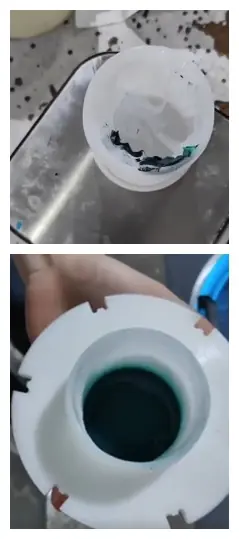
Introduction
Mixing multiple ultra-high-viscosity materials into a uniform formulation can be challenging, particularly when both components are dense, non-flowing pastes with high internal yield stress and different flow characteristics.
In this application trial, a customer required a completely homogeneous blend of an ultra-high-viscosity resin base and a dense pigment paste (ink concentrate) for high-precision manufacturing. Berlon initially evaluated the formulation using a standard single-motor planetary centrifugal mixer. Although single-motor systems allow overall revolution speed adjustment (typically 0 to 2,500 RPM), their rotation-to-revolution speed ratio is fixed. As a result, adjusting the speed scales both motions proportionally, which in this trial produced subtle color streaking and minor material separation post-mixing.
To address this challenge, a secondary test was conducted utilizing a dual-motor planetary centrifugal vacuum mixer—a system designed with independent control over both revolution and rotation speeds. By decoupled speed control and optimizing the motion ratio to accommodate two high-viscosity pastes, the dual-motor system successfully achieved a completely uniform mixture with zero visible air bubbles.
.
Customer Requirement
The customer needed to combine an ultra-high-viscosity resin base with a secondary high-viscosity pigment paste into a fully dispersed, uniform color blend.
The primary technical requirements were:
Uniform Color & Component Distribution: Homogeneous, streak-free integration of the dense pigment paste into the resin matrix.
Structural Stability: Highly stable mixing under high shear forces without thermal or structural degradation.
Phase Consistency: Zero visible phase separation, color marbling, or unmixed paste agglomerates after the mixing cycle.
Degassing Performance: Complete elimination of entrapped air pockets and micro-bubbles generated during loading and processing.
Initial Test with a Single-Motor Mixern
The preliminary trial was performed on a standard single-motor planetary centrifugal mixer.
In a single-motor drive architecture, the machine allows the operator to set the revolution speed across a wide operating range (e.g., 0 to 2,500 RPM). However, because the container's rotational axis is mechanically linked to the central shaft via a fixed gearing mechanism, the rotation speed automatically scales in a constant, predetermined ratio relative to the revolution speed.
The resin and pigment paste were processed under baseline single-motor parameters. Increasing or decreasing the machine's RPM changed the total energy input, but the proportional relationship between centrifugal acceleration (revolution) and shear rate (rotation) remained locked. While the equipment successfully combined the primary bulk volume of the two components, subtle pigment streaking and minor micro-separation remained visible upon close visual inspection following the cycle.
This initial result indicated that adjusting the speed of a fixed-ratio drive did not provide the precise balance of centrifugal force and shear required to break down and fold these two specific high-viscosity pastes.
Engineering Analysis
For complex formulations involving paste-to-paste mixing (combining two dense, non-fluid components), achieving micro-level dispersion depends entirely on generating sufficient rotational shear forces to continuously fold and redistribute the materials throughout the container.
In a single-motor configuration, ramping up the speed to increase rotational shear inevitably increases centrifugal acceleration by the same proportion. For dense pastes with high yield stress, excessive centrifugal force can lock the paste firmly against the vessel wall, restricting internal material circulation and creating shear dead zones.
Transitioning to a dual-motor configuration allows engineers to decouple these two physical vectors:
Revolution Speed (0–2,500 RPM): Adjusted to provide appropriate material turnover and flat surface geometry for degassing.
Rotation Speed: Independently adjusted to deliver the exact shear rate needed to knead and disperse the concentrated pigment paste within the resin base.
Engineering Compliance Note: The initial test did not imply equipment limitations; rather, it demonstrated that fixed-ratio mechanics locked the relationship between shear and centrifugal forces, limiting process optimization for this specific paste-to-paste formulation.
Second Test with a Dual-Motor Mixer
For the second evaluation, we used a dual-motor planetary centrifugal vacuum mixer.
Unlike single-motor architectures, the dual-motor system utilizes separate power units to drive revolution (0–2,500 RPM) and rotation independently. This enables application engineers to adjust the rotation-to-revolution speed ratio dynamically according to the viscosity, density, and flow behavior of the raw materials.
The resin and pigment paste formulation was processed under vacuum using an optimized, decoupled speed profile that elevated rotational shear without over-pressurizing the paste against the wall.
The second test produced a significantly more uniform mixture. No pigment streaking or material separation was observed post-mixing, and the final formulation was entirely free of entrapped micro-bubbles.
Test Comparison
A side-by-side comparison highlights the key parameter adjustments and visual outcomes between the two processing trials:
| Parameter / Metric | Initial Trial | Optimized Trial |
|---|---|---|
| Material Formulation | Viscous resin + High-viscosity pigment paste | Viscous resin + High-viscosity pigment paste |
| Drive Architecture | Single-motor planetary mixer | Dual-motor planetary mixer Upgraded |
| Revolution Speed Range | Adjustable (0–2,500 RPM) | Adjustable (0–2,500 RPM) |
| Kinematic Speed Ratio | Fixed rotation-to-revolution ratio | Independently adjustable ratio |
| Material Uniformity | Subtle color streaking / slight separation | Completely uniform & homogeneous color |
| Visible Air Bubbles | None observed | None observed |
| Process Control | Linked shear/centrifugal scaling | Decoupled shear & centrifugal control |
Why Adjustable Rotation-to-Revolution Ratio Matters
Planetary centrifugal mixers rely on the combined vector forces of rotation and revolution to generate complex, non-contact material circulation inside the container:
Revolution (Centrifugal Acceleration): Drives dense materials outward toward the vessel boundary and flattens the paste surface to accelerate vacuum degassing.
Rotation (Shear & Folding): Induces internal velocity gradients that continually shear, fold, and roll high-viscosity paste structures.
While single-motor mixers effectively process a wide range of standard formulations by adjusting overall RPM (0–2,500 RPM), multi-component paste formulations often require decoupled parameter control. Independent adjustment allows engineers to increase shear rate to smear dense pigment agglomerates into the resin without creating excessive centrifugal compaction or thermal buildup.
This operational flexibility is essential when processing shear-dependent materials, paste inks, conductive pastes, or highly filled polymers where achieving uniform dispersion requires a specific kinematic ratio rather than simply higher motor speed.
Result
After switching to the dual-motor configuration and fine-tuning the rotation-to-revolution speed ratio, the resin and pigment paste formulation achieved a uniform, stable mixture.
The final material demonstrated:
Homogeneous Component Distribution: Consistent tinting with complete elimination of color streaking.
Zero Visible Separation: Complete blend stability with no phase separation under room-temperature resting.
High Degassing Quality: Absolute elimination of entrapped air pockets and microscopic void bubbles.
The trial proved that an independently adjustable rotation-to-revolution motion provided a far more suitable processing configuration for this specific formulation.
Engineering Takeaway
Mixing speed is not the only variable that matters.
While single-motor mixers offer flexible speed control (0–2,500 RPM), their fixed gear ratio links centrifugal force and shear rate together. For ultra-high-viscosity, multi-component paste formulations, the dynamic relationship between rotation and revolution directly governs internal fluid dynamics and blend uniformity.
In this application, transitioning to an independently adjustable dual-motor system provided the process flexibility needed to decouple shear from centrifugal force, ultimately yielding a high-quality, streak-free, and bubble-free product.
Need to Mix a High-Viscosity or Multi-Component Material?
Material viscosity, yield stress, vessel geometry, and kinematic forces all dictate mixing success. Berlon’s technical team provides comprehensive application testing and custom engineering to help you identify the optimal equipment profile for your formulation.


